

The most honest answer to “how many IPL sessions will I need” is “it depends on what we are treating.” That answer is correct and almost completely useless. Patients want a number they can plan around. They want to know whether a summer of sun spots will take two visits or six, and whether the redness across their cheeks will keep responding indefinitely or top out after a few rounds.
This guide gives the real numbers. It walks through the typical session counts for each concern IPL handles well, the variables that move the count up or down for your specific skin, and the maintenance cadence once the initial series is finished. Wherever a related treatment has its own deeper page on the site, we have linked to it.
What IPL actually does at the skin level
Intense pulsed light is a broad-spectrum light device that delivers carefully filtered wavelengths into the skin. The light energy is selectively absorbed by two main targets: melanin (the pigment in brown spots, age spots, freckles, and some scar discoloration) and hemoglobin (the pigment in blood vessels, including the diffuse redness of rosacea and the visible vessels of telangiectasias).
Once the energy is absorbed by those targets, it converts to heat inside the pigmented or vascular structure. The body then clears the broken-down material over the following days and weeks. The surrounding healthy skin is largely unaffected because the filtered wavelengths bypass it.
This is why IPL photofacial in Winston-Salem is so effective for surface pigmentation and vascular concerns at the same time. The same session can fade brown spots and quiet redness, since both pigments are valid targets for the device.
The honest range: most people need 3 to 5 sessions
The shortest accurate answer most patients can build a plan around is this: a typical initial series runs three to five sessions, spaced about four weeks apart. Some patients see meaningful improvement after a single session. Others need six or more before a stubborn concern fully clears. The number depends on what you are treating, how long it has been on your skin, how disciplined you are with sun protection during the series, and how your skin responds along the way.
Published clinical research supports that range. A study of 31 patients treated for solar lentigines (sun spots) on the back of the hands found that 62% of patients achieved more than 50% improvement and 23% achieved more than 75% improvement after up to five sessions spaced one month apart (Source: Kawada et al., 2012, PubMed). Larger retrospective studies of facial IPL have reported high effective-treatment rates in the photoaging category overall.
The takeaway: meaningful change is the expectation. Full clearance is sometimes possible. Significant improvement is the more reliable promise.
Typical session counts by concern
The table below covers the conditions IPL treats most effectively. Every number assumes a patient who follows the recommended pre- and post-care protocol, uses daily SPF, and avoids active sun exposure during the series.
Concern | Typical sessions | Spacing | Realistic outcome |
|---|---|---|---|
Sun spots and solar lentigines | 3 to 5 | About 4 weeks | Significant fading; many spots clear completely |
Diffuse redness and flushing | 4 to 6 | 3 to 4 weeks | Visible reduction in baseline redness |
Rosacea (vascular component) | 4 to 6 | About 4 weeks | Quieter background, fewer flare cycles |
Broken capillaries and telangiectasias | 2 to 4 | About 4 weeks | Targeted vessels fade, sometimes after one session |
Freckles and ephelides | 2 to 4 | About 4 weeks | Substantial lightening, with sun-exposure caveats |
Overall photoaging and dullness | 4 to 6 | About 4 weeks | Brighter tone, more even surface |
Mild inflammatory acne | 4 to 6 | 2 to 3 weeks | Reduced lesion count and post-inflammatory marks |
What changes the number for you
Two patients with the same diagnosis can need very different session counts. The variables that move the count are predictable, and most of them are visible during a consultation.
Skin type and tone. Lighter skin types (Fitzpatrick I through III) typically respond to IPL with fewer sessions because the contrast between target pigment and surrounding skin is high. Medium to darker skin types (IV and above) require more conservative settings to protect against post-inflammatory hyperpigmentation, which often translates to additional sessions at a gentler intensity. Some darker skin types are better treated with a different device altogether, and an honest consultation should say so.
Depth and density of the pigment. Surface brown spots that have appeared in the last few years respond faster than deeply rooted pigmentation that has been accumulating for decades. A scattering of sun damage from a recent summer is usually a shorter series than the layered photodamage of a lifelong gardener.
The type of redness. Discrete broken capillaries often respond to a single session. Diffuse rosacea-related redness usually needs four to six. The vascular pattern dictates the count, not the patient’s frustration level with the condition.
Sun exposure during the series. Active tanning during a course of IPL can stall progress and increase the risk of complications. Patients who shield the treated area aggressively tend to need fewer sessions overall.
Skincare baseline. Patients already using medical-grade sunscreen, a vitamin C serum, and a tyrosinase-inhibiting topical typically see faster, cleaner results. Skin that arrives at IPL with good support requires less work from the device.
The shortest path to results: Strict daily SPF, no active tanning, a calm skincare routine during the series, and patience between visits. Patients who follow this consistently almost always need fewer sessions than the upper end of the range we quoted. |
What melasma changes in the conversation
Melasma deserves its own paragraph because it behaves unlike other forms of pigmentation. It is hormonally driven, heat-sensitive, and prone to rebounding when treated too aggressively. IPL can play a role for some melasma patients, but only at low, conservative settings, often paired with topical lightening agents and oral tranexamic acid where appropriate. A typical melasma protocol involves slower, gentler sessions and a longer planning horizon than the standard sun-spot series.
If your primary concern is melasma, the consultation should weigh IPL against alternatives such as NOUVADerm laser resurfacing in Winston-Salem, which uses a 1927 nm thulium wavelength specifically chosen for its low risk of rebound hyperpigmentation. The right tool depends on your skin type, your trigger pattern, what has been tried before, and your tolerance for the longer treatment runway melasma protocols require.
What a session feels like and what happens between them
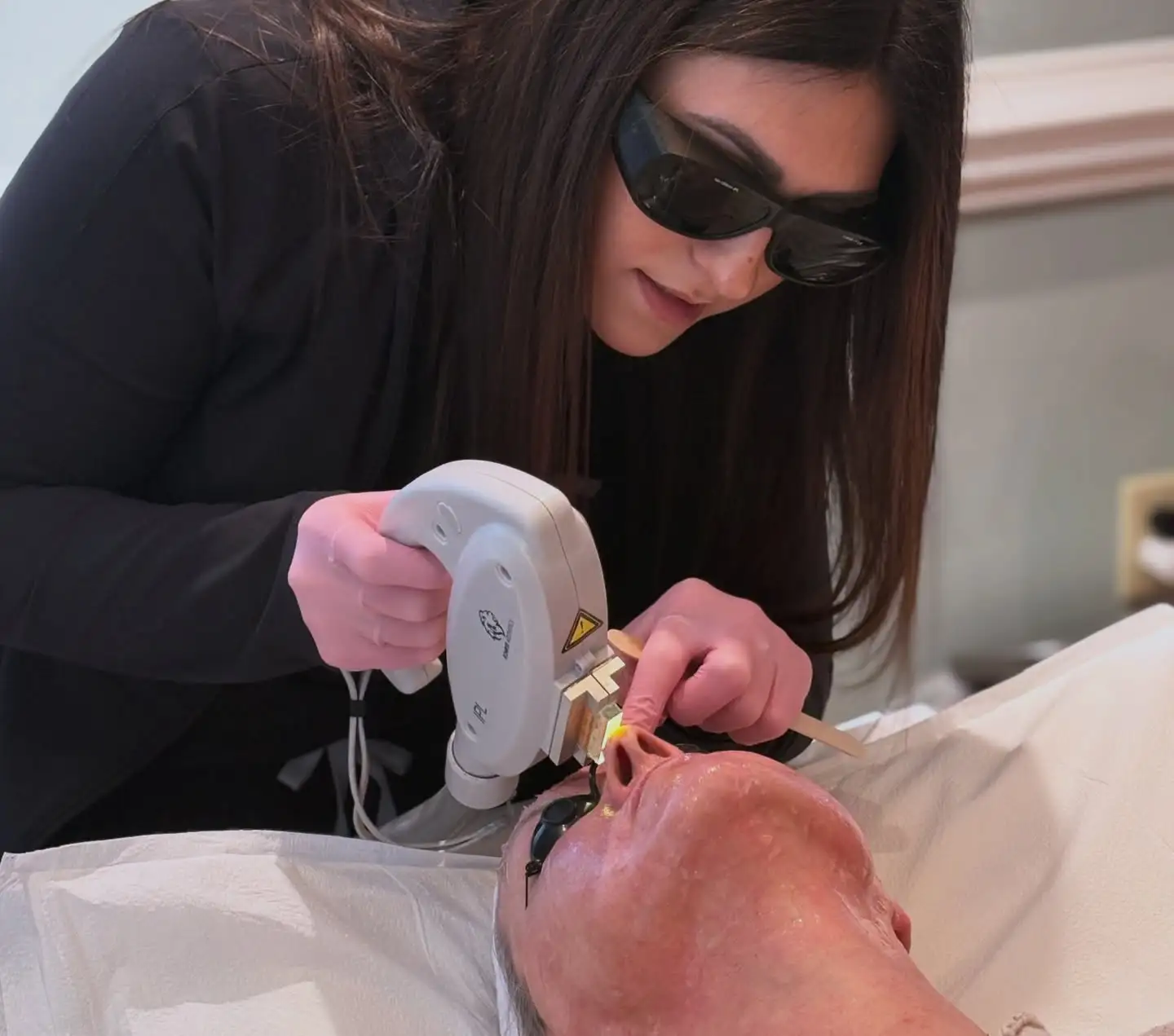
A single IPL session takes between twenty and forty-five minutes depending on the treatment area. Most patients describe the sensation as a quick warm snap, similar to a rubber band against the skin, followed by a residual warmth that fades within an hour. Brown spots often look darker for the first three to seven days after treatment, then flake off as the body clears the pigment. Redness from vascular treatment usually softens visibly within a week.
The four-week spacing between sessions is intentional. It gives the skin time to clear the previous round of pigment, allows any inflammation to settle, and lets your provider assess how much your skin responded before adjusting settings for the next visit. Patients who try to compress this schedule rarely save time. They more often extend the series by creating inflammation that has to resolve before the next treatment can proceed.
Maintenance after the initial series
Once the initial series ends, most patients move into a maintenance cadence of one or two sessions per year. The reason is structural. IPL clears pigment and quiets vessels that already exist. It does not change the underlying biology that produces them. Without daily sun protection and a thoughtful skincare routine, new spots will appear over time. With consistent care, maintenance sessions can hold the result for years.
A reasonable maintenance schedule for most patients in the Piedmont Triad looks like this:
- One IPL session in early spring, before sun exposure increases, focused on any new pigmentation that emerged over the previous year.
- A second session in late fall if your skin still shows vascular activity or accumulated brown spots from summer.
For patients who maintain rigorous sun protection year-round, a single annual session is often enough.
Common mistakes that lengthen the series
A handful of behaviors push the session count toward the upper end of every range above. Awareness of them is usually enough to avoid them.
The most consequential is sun exposure during the series. Even a moderate amount of incidental sun, the kind that happens on a weekend hike or a family event by the pool, can stall progress and force a delay between sessions. IPL was developed for photodamaged skin, and recently tanned skin behaves like a moving target for the device.
The second is skipping topicals between sessions. Patients who use medical-grade SPF, vitamin C, and an appropriate pigment-inhibitor between visits get more out of every appointment than patients who treat IPL as a standalone reset.
The third is asking for higher intensity to “speed things up.” Aggressive settings can produce post-inflammatory hyperpigmentation, especially in medium to darker skin types, and the resulting brown patches take longer to clear than the original concern would have. Slow and steady almost always produces the cleaner result.
How IPL fits into a broader plan
IPL handles surface pigmentation and visible vessels exceptionally well. It does less for fine lines, textural irregularities, deep scarring, or the laxity that develops with age. The patients who see the most dramatic transformations almost always pair IPL with treatments that address those other layers.
For texture and pigmentation that sits deeper than IPL can reach, NOUVADerm laser resurfacing handles fine lines, early scarring, and uneven surface tone within the same overall plan. For overall skin quality and a glow that holds between IPL sessions, HydraFacial treatments in Winston-Salem keep the surface exfoliated, hydrated, and ready to respond. For patients addressing volume loss alongside surface concerns, dermal filler in Winston-Salem and plasma gel restore the scaffolding underneath. For patients investing in long-term skin health, layering IPL with PRP in Winston-Salem and other regenerative approaches builds collagen support the device alone cannot deliver.
A real plan rarely uses one device exclusively. The work sits in sequencing the right tools for the layers of skin that need them.